Protein biosynthesis
Core biological process producing proteins from DNA instructions.
Cells constantly make new proteins to replace those lost through breakdown or export. This process, called protein biosynthesis or protein synthesis, is essential for life. Proteins serve as enzymes, structural components, and hormones. While the basic steps are similar in prokaryotes and eukaryotes, there are key differences.
Protein synthesis happens in two main stages: transcription and translation. In transcription, a gene—a DNA segment coding for a protein—is copied into messenger RNA (mRNA). Enzymes called RNA polymerases carry out this conversion inside the nucleus. In eukaryotes, the initial copy is a premature form (pre-mRNA) that must undergo post-transcriptional modifications to become mature mRNA. This mature mRNA then exits the nucleus through nuclear pores into the cytoplasm. During translation, ribosomes read the mRNA sequence and use it to determine the order of amino acids. The ribosomes catalyze the formation of covalent peptide bonds between these amino acids, building a polypeptide chain.
After translation, the polypeptide chain must fold into a functional shape. For example, an enzyme needs a correctly folded active site to work. Folding begins with the formation of smaller secondary structures, which then arrange into the overall three-dimensional tertiary structure. Once folded, the protein may undergo further maturation through post-translational modifications. These changes can affect the protein’s function, its location within the cell (such as the cytoplasm or nucleus), and its ability to interact with other proteins.
Errors in protein biosynthesis often underlie disease. DNA mutations alter the mRNA sequence, which in turn changes the amino acid sequence of the polypeptide. A mutation might introduce a premature stop signal, shortening the chain, or it might swap one amino acid for another. Such changes can impair the protein’s function or its ability to fold correctly. Misfolded proteins tend to form dense clumps, which are linked to neurological disorders like Alzheimer’s and Parkinson’s disease.
**Transcription**
Transcription takes place in the nucleus, using DNA as a template to produce mRNA. In eukaryotes, the initial product is pre-mRNA, which undergoes post-transcriptional modifications inside the nucleus to become mature mRNA. In prokaryotes, no such modifications are needed; transcription directly yields mature mRNA.
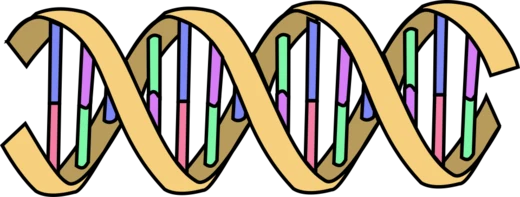
First, an enzyme called helicase acts on the DNA molecule. DNA has an antiparallel double helix, with two complementary strands held together by hydrogen bonds between base pairs. Helicase breaks these bonds, unwinding a region of DNA (corresponding to a gene) and exposing the bases. Only one of the two strands serves as the template for pre-mRNA synthesis; this is the template strand. The other strand, complementary to the template, is called the coding strand.
DNA and RNA have directionality, meaning each molecule has two distinct ends. This arises from the asymmetric structure of nucleotides: a phosphate group on one side of the pentose sugar and a base on the other. The five carbons in the sugar are numbered 1' to 5'. Phosphodiester bonds link the 3' carbon of one nucleotide to the 5' carbon of the next. Thus, the coding strand runs 5' to 3', while the complementary template strand runs 3' to 5'.
RNA polymerase binds to the exposed template strand and reads it in the 3' to 5' direction. As it moves, it synthesizes a single strand of pre-mRNA in the 5' to 3' direction, catalyzing the formation of phosphodiester bonds between free nucleotides that base-pair with the template. Behind the moving polymerase, the two DNA strands rejoin, so only about 12 base pairs are exposed at any time. RNA polymerase builds pre-mRNA at about 20 nucleotides per second, allowing thousands of copies from the same gene in an hour. Despite this speed, the enzyme has a proofreading mechanism: it can remove incorrect nucleotides (those not complementary to the template) via an excision reaction. When RNA polymerase reaches a specific DNA sequence that signals termination, it detaches, and pre-mRNA synthesis is complete.
The resulting pre-mRNA is complementary to the template DNA strand and identical in sequence to the coding DNA strand, except for one key difference: RNA uses uracil instead of thymine.
- field
- Molecular biology
- known_for
- Transcription and translation of genetic information into functional proteins
Lore & Background
Protein synthesis can be divided into two phases: transcription and translation. During transcription, a section of DNA encoding a protein (a gene) is converted into messenger RNA (mRNA) by RNA polymerases in the nucleus. In eukaryotes, this mRNA is initially produced as pre-mRNA, which undergoes post-transcriptional modifications—including addition of a 5' cap, a 3' poly(A) tail, and removal of introns via splicing—to form mature mRNA. The mature mRNA is exported to the cytoplasm for translation. During translation, ribosomes read the mRNA in a 5'-to-3' direction and use transfer RNAs to deliver the correct amino acids, catalyzing the formation of covalent peptide bonds to build a polypeptide chain. After translation, the polypeptide must fold into secondary structures and then a tertiary structure to become functional. Further maturation may occur through post-translational modifications, affecting the protein's function, location, or interactions. Errors in protein biosynthesis—from DNA mutations or protein misfolding—are often underlying causes of disease. Mutations can alter the mRNA sequence, leading to a changed amino acid sequence or early termination. Misfolded proteins tend to form dense clumps implicated in neurological disorders such as Alzheimer's and Parkinson's disease.
Reader's Guide
Protein biosynthesis is fundamental to all life, as it produces the enzymes, structural proteins, and hormones that cells require. The process involves two main stages: transcription, where DNA is transcribed into mRNA, and translation, where ribosomes synthesize polypeptide chains from the mRNA template. In eukaryotes, transcription occurs in the nucleus and includes post-transcriptional modifications; in prokaryotes, both stages occur in the cytoplasm. The fidelity of this process is critical: RNA polymerase has a proofreading mechanism to remove incorrect nucleotides, and the 5' cap and poly(A) tail help ensure mRNA integrity. Errors, such as DNA mutations that change the amino acid sequence or cause early termination, can lead to protein misfolding and aggregation, which are linked to diseases like Alzheimer's and Parkinson's. Understanding protein biosynthesis has thus been essential for elucidating the molecular basis of many disorders and for developing therapeutic strategies.
Did You Know?
- RNA polymerase builds pre-mRNA at a rate of 20 nucleotides per second, enabling production of thousands of pre-mRNA molecules from the same gene in an hour.
- The 5' cap added to pre-mRNA is composed of a guanine nucleotide modified through methylation.
- Only 12 base pairs of DNA are exposed at one time during transcription as the two DNA strands rejoin behind the moving RNA polymerase.
- Misfolded proteins have a tendency to form dense protein clumps, often implicated in neurological disorders including Alzheimer's and Parkinson's disease.
Frequently Asked Questions
Who is Protein biosynthesis?
Protein biosynthesis is the fundamental cellular process that converts the instructions stored in DNA into working proteins. It operates in every living cell, from bacteria to humans, and is the mechanism by which genetic code becomes functional molecular machinery.
What are Protein biosynthesis's powers/role?
Its primary role is to transcribe and translate genetic information into functional proteins that can act as enzymes, structural components, or hormones. Without this process, cells would lack the molecular tools needed to carry out virtually every task.
How does Protein biosynthesis's story end?
The process concludes when a newly assembled polypeptide folds into its functional shape and is deployed to perform its assigned role in the cell. That finished protein then begins its work—catalyzing reactions, building structures, or signaling to other cells—until it eventually degrades and the cycle restarts.
Why is Protein biosynthesis important?
It continuously replaces proteins that are lost or degraded, maintaining the cellular inventory needed for survival. Without this ongoing production, cells would quickly lose their enzymatic, structural, and hormonal capacity and cease to function.
How does Protein biosynthesis differ between prokaryotes and eukaryotes?
The overall two-step logic of transcription followed by translation is shared across both groups, but the specific machinery, timing, and compartmentalization differ. In eukaryotes, transcription occurs in the nucleus while translation happens in the cytoplasm, whereas prokaryotes couple the two steps in the same compartment.
More in Cell And Molecular Biology 1-24
Spotted an error? Know more?
This is a living reference — every entry is fact-audited, and reader corrections feed straight into our audit queue. Suggest an edit · See this site's audit record