
Lipopolysaccharide
Major component of Gram-negative bacterial outer membrane.

Ninjatacoshell · Public domain
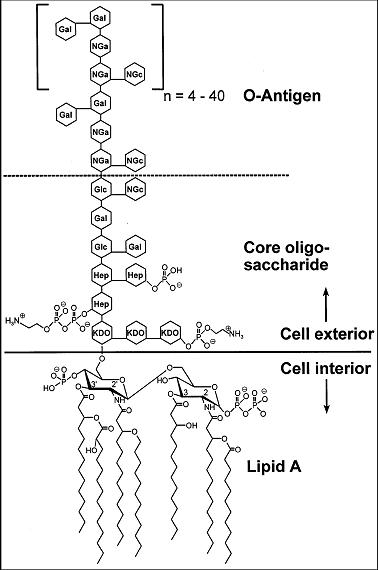
Lipopolysaccharide (LPS) is a major component of the outermost membrane of the cell envelope of Gram-negative bacteria, such as E. coli and Salmonella, with a common structural architecture. LPS is a large molecule consisting of three parts: a distal polysaccharide chain called the O-antigen, a core oligosaccharide (which itself has outer and inner regions), and lipid A, the toxic component from which the term endotoxin is derived. Note that LPS is not synonymous with endotoxin; endotoxin specifically refers to the toxic lipid A portion, not the entire molecule. LPS is a potent activator of the immune system and a pyrogen, and in severe cases can trigger septic shock.
- composition
- O-antigen, core oligosaccharide (outer and inner regions), lipid A
Lore & Background
The toxic activity of lipid A was first discovered and termed endotoxin by Richard Friedrich Johannes Pfeiffer, who distinguished between exotoxins and endotoxins. Subsequent work showed that LPS release does not necessarily require destruction of the bacterial cell wall, but can occur via bacterial outer membrane vesicles. LPS is a major component of the outer cell membrane of Gram-negative bacteria, contributing to structural integrity and protecting the membrane from chemical attack. It is the most abundant antigen on the cell surface of most Gram-negative bacteria, typically constituting about 30-40% of the outer membrane by weight, though it can make up about 80% of the outer leaflet of the outer membrane of E. coli and Salmonella.
Reader's Guide
Lipopolysaccharide is of crucial importance to many Gram-negative bacteria, which die if the genes coding for it are mutated or removed, though it appears nonessential in some species such as Neisseria meningitidis. LPS has substantial impacts on human health primarily through interactions with the immune system. It is a potent activator of the immune system and a pyrogen, and in severe cases can trigger septic shock. At lower levels over longer time periods, LPS may play a harmful role in autoimmunity, obesity, depression, and cellular senescence. The lipid A domain is the most bioactive and responsible for much of the toxicity of Gram-negative bacteria. A highly conserved host enzyme called acyloxyacyl hydrolase (AOAH) may detoxify LPS when it enters animal tissues. Dephosphorylation of LPS by intestinal alkaline phosphatase can reduce the severity of certain infections. The LPS transport system is a potential antibiotic target.
Did You Know?
- LPS is often called endotoxin, but endotoxin specifically refers to the lipid A component, not the whole LPS molecule. Note that the term 'endotoxin' in medical and immunological contexts is reserved for the lipopolysacc
Tripartite Molecular Architecture
Lipopolysaccharide is an amphipathic macromolecule assembled from three covalently linked domains, each with a distinct chemical character and biological role. The outermost region is the O-antigen, a repetitive glycan polymer that is hydrophilic and extraordinarily variable; E. When a full-length O-chain is present the molecule is classified as smooth, whereas its absence or truncation yields a rough form whose more hydrophobic surface renders the cell membrane more penetrable to certain antibiotics. Beneath the O-antigen sits the core oligosaccharide, a less variable hydrophilic region that commonly incorporates sugars such as heptose and KDO (3-Deoxy-D-manno-oct-2-ulosonic acid) along with non-carbohydrate substituents including phosphate groups, amino acids, and ethanolamine. The innermost domain, lipid A, is a hydrophobic, phosphorylated glucosamine disaccharide decorated with multiple fatty-acid chains. These chains anchor the entire structure into the bacterial outer membrane, while the hydrophilic portions project outward into the aqueous environment.
Essentiality and Ecological Roles in Gram-Negative Bacteria
For most Gram-negative organisms, lipopolysaccharide is not merely a surface decoration but a load-bearing component of the outer membrane. In species such as E. coli and Salmonella, LPS can account for as much as eighty percent of the outer membrane, contributing to structural integrity, shielding the cell from chemical attack, and increasing the overall negative surface charge that stabilises membrane architecture. For many of these bacteria the molecule is absolutely essential: mutating or deleting the genes responsible for its synthesis is lethal. Yet the picture is not universal. In Neisseria meningitidis, Moraxella catarrhalis, and Acinetobacter baumannii, LPS appears dispensable, and these organisms instead carry a shorter lipooligosaccharide that fulfils a similar membrane-stabilising role. Beyond basic survival, LPS participates in a range of ecological interactions. It mediates surface adhesion, influences sensitivity to bacteriophage infection, and modulates encounters with predatory amoebae. It is also a prerequisite for the activity of omptins, a class of bacterial proteases. In pathogens such as Neisseria and Haemophilus, the shorter LOS molecules additionally serve as immunostimulators and immunomodulators, and they enable molecular mimicry and antigenic diversity that help the bacterium evade host immune surveillance.
From Pfeiffer's Endotoxin to Membrane Vesicles
The toxic properties of what we now call lipopolysaccharide were first identified by Richard Friedrich Johannes Pfeiffer, who coined the term endotoxin to describe substances that reside inside the bacterial cell and are liberated only when the outer membrane is breached. He drew a clear line between these intracellular toxins and exotoxins, which bacteria actively secrete into their surroundings. For decades the prevailing assumption was that LPS reached the host bloodstream exclusively through cell lysis. Modern research has complicated that picture considerably. LPS can be shed as part of routine physiological activity: Gram-negative bacteria package it into outer membrane vesicles that bud from the cell surface, and these vesicles may carry additional virulence factors and proteins alongside the endotoxin. Thus, release of LPS does not strictly require destruction of the bacterial cell wall. It is also worth noting that the word endotoxin carries a broader historical meaning. A few agents, such as the delta endotoxin proteins produced by Bacillus thuringiensis, are genuine intracellular toxins released upon cell disintegration but bear no structural relationship to lipopolysaccharide at all.
A Double-Edged Sword in Human Physiology
The same structural features that make lipopolysaccharide indispensable to Gram-negative bacteria make it a formidable trigger for the human immune system. Lipid A, the most conserved and bioactive domain, is the principal source of toxicity. When immune cells lyse bacterial membranes, fragments bearing lipid A can enter the circulation and provoke fever, diarrhoea, and, in extreme cases, a cascading systemic response that culminates in endotoxic septic shock accompanied by multiple acute organ failures. Even at sub-lethal concentrations, however, the story does not end. Emerging evidence suggests that chronic, low-level exposure to LPS may contribute to a spectrum of conditions including autoimmunity, obesity, depression, and accelerated cellular senescence. In pathogens that carry lipooligosaccharide rather than full-length LPS, such as Neisseria and Haemophilus species, the shorter glycolipid still acts as a potent immunostimulator and immunomodulator. Its capacity to display molecular mimicry and antigenic diversity further complicates host–pathogen interactions, giving these organisms a sophisticated toolkit for evading immune recognition while simultaneously provoking inflammatory damage.
Gallery

Frequently Asked Questions
Who is Lipopolysaccharide?
LPS is the dominant structural glycolipid lining the outermost leaflet of the outer membrane in Gram-negative bacteria such as E. coli and Salmonella. It forms the defining architectural feature of these organisms' cell envelope.
What are Lipopolysaccharide's powers/role?
LPS acts as the principal exterior barrier and recognition surface of Gram-negative cells, shielding the bacterium from host defenses. Its lipid A moiety is a potent innate-immune trigger that activates macrophages and other immune cells through pattern-recognition receptors.
How does Lipopolysaccharide's story end?
When LPS is shed or released during bacterial lysis, its lipid A component—often called endotoxin—drives an intense inflammatory cascade that can culminate in septic shock. In this sense, the 'ending' is a dramatic, potentially lethal immune overreaction in the host.
Why is Lipopolysaccharide important?
LPS sits at the crossroads of bacterial survival, host-pathogen interaction, and clinical medicine, making it a key target in vaccine design, antibiotic development, and sepsis research. Its O-antigen structure also provides a species-specific fingerprint used in serotyping and taxonomic identification of Gram-negative organisms.
What is Lipopolysaccharide made of?
Each LPS molecule is assembled from three distinct regions: a distal O-antigen polysaccharide chain, a core oligosaccharide with outer and inner subregions, and the membrane-anchored lipid A. It is important to note that 'endotoxin' refers specifically to the toxic lipid A portion, not the entire LPS structure.
More in Cell And Molecular Biology 1-24
Elsewhere in the Cell And Molecular Biology universe
Spotted an error? Know more?
This is a living reference — every entry is fact-audited, and reader corrections feed straight into our audit queue. Suggest an edit · See this site's audit record