Nucleic acid structure
DNA and RNA structure organized into primary, secondary, tertiary, and quaternary levels.

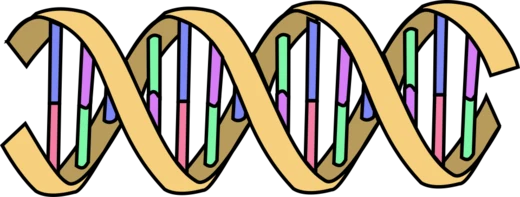
Nucleic acid structure refers to the structure of nucleic acids such as DNA and RNA. Chemically speaking, DNA and RNA are very similar. Nucleic acid structure is often divided into four different levels: primary, secondary, tertiary, and quaternary.
- primary_structure
- Linear sequence of nucleotides linked by phosphodiester bonds
- secondary_structure_DNA
- Double helix held by hydrogen bonds and base stacking
- secondary_structure_RNA
- Single polynucleotide with helices, bulges, loops, and junctions
- tertiary_structure_forms
- B-DNA, A-DNA, Z-DNA
- base_pairing_rules
- Purine with pyrimidine: G-C, A-T (DNA), A-U (RNA)
Lore & Background
Nucleic acid structure encompasses the molecular organization of DNA and RNA. Primary structure consists of a linear sequence of nucleotides linked by phosphodiester bonds, with nucleotides containing a nitrogenous base (adenine, guanine, cytosine, thymine in DNA, uracil in RNA), a 5-carbon sugar (deoxyribose in DNA, ribose in RNA), and phosphate groups. The polarity in DNA and RNA derives from oxygen and nitrogen atoms in the backbone. Secondary structure involves interactions between bases: in DNA, two strands form a double helix held together by hydrogen bonds and stabilized by stacking interactions, with major and minor grooves. In RNA, secondary structure includes helices, bulges, loops, junctions, stem-loops, tetraloops (such as UNCG, GNRA, CUUG), and pseudoknots.
Reader's Guide
The study of nucleic acid structure is fundamental to understanding genetic information storage and expression. The four levels—primary, secondary, tertiary, and quaternary—provide a framework for analyzing how DNA and RNA function. Primary structure determines the genetic code, while secondary structure dictates base pairing and helical formation. Tertiary structure, including B-DNA, A-DNA, and Z-DNA, describes three-dimensional folding influenced by hydration, salt concentration, and sequence. B-DNA is the most common in vivo, with a wide major groove accessible to proteins. A-DNA forms under dehydrating conditions and is shorter and wider, while Z-DNA is a left-handed helix requiring alternating purine-pyrimidine sequences. RNA secondary structure elements like pseudoknots have diverse functions. Understanding these structures aids in predicting molecular interactions and biological roles.
Did You Know?
- Nucleotides consist of a nitrogenous base, a 5-carbon sugar, and one or more phosphate groups.
- DNA's secondary structure is predominantly determined by base-pairing of two polynucleotide strands wrapped around each other to form a double helix.
- Z-DNA is a relatively rare left-handed double helix that requires an alternating purine-pyrimidine sequence.
- Pseudoknots are functional RNA secondary structures first identified in turnip yellow mosaic virus.
More in Cell And Molecular Biology 1-24
Elsewhere in the Cell And Molecular Biology universe
Spotted an error? Know more?
This is a living reference — every entry is fact-audited, and reader corrections feed straight into our audit queue. Suggest an edit · See this site's audit record