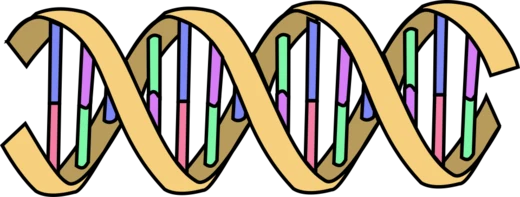
Plastid DNA
Plastid DNA, often called chloroplast DNA in photosynthetic organisms, is the genetic material found inside chloroplasts and other plastids like apicoplasts. This DNA is separate from the nuclear genome. Its existence was first shown biochemically in 1959, and confirmed under an electron microscope three years later. The later discovery that chloroplasts have their own ribosomes and can make proteins proved they are genetically semi-autonomous. The first complete chloroplast genomes were published in 1986—one from tobacco and one from liverwort—and since then, tens of thousands more have been sequenced.
**Molecular structure**
Chloroplast DNA molecules are circular, typically 120,000 to 170,000 base pairs long. They measure about 30 to 60 micrometers in contour length and weigh roughly 80 to 130 million daltons. Most chloroplasts carry their entire genome as a single large ring, but dinophyte algae are an exception: their genome is split into about forty small plasmids, each 2,000 to 10,000 base pairs long. Each minicircle holds one to three genes, though some blank plasmids with no coding DNA exist. While chloroplast DNA was long assumed to be circular, some evidence suggests it more often takes a linear shape. In corn chloroplasts, over 95% of the DNA appears as branched linear forms rather than individual circles.
**Inverted repeats**
Many chloroplast genomes contain two inverted repeats, which separate a long single-copy section from a short single-copy section. These repeats vary greatly in length, from 4,000 to 25,000 base pairs each. In plants, they tend toward the upper end, typically 20,000 to 25,000 base pairs. The inverted repeats usually include three ribosomal RNA genes and two tRNA genes, but can be expanded or reduced to contain as few as four or as many as over 150 genes. Although a given pair is rarely perfectly identical, they are always very similar, likely due to concerted evolution. These repeats are highly conserved among land plants and accumulate few mutations. Similar inverted repeats appear in cyanobacteria and the other two chloroplast lineages (glaucophytes and red algae), suggesting they predate the chloroplast itself. However, some chloroplast genomes—like those of peas and a few red algae—have lost the repeats. Others, such as the red alga *Porphyra*, have flipped one repeat, making them direct repeats. It is thought the inverted repeats help stabilize the rest of the genome, since chloroplasts that lose parts of these repeats tend to undergo more rearrangements.
**Nucleoids**
In young leaves, each chloroplast contains about 100 copies of its DNA, dropping to 15–20 copies in older leaves. These copies are usually packed into nucleoids, each holding several identical DNA rings, and many nucleoids can be found in a single chloroplast. Chloroplast DNA is not associated with true histones, but in red algae, a histone-like protein called HC, encoded by the chloroplast DNA, tightly packs each ring into a nucleoid. In primitive red algae, these nucleoids cluster in the center of the chloroplast, while in green plants, they are scattered throughout the stroma.
**Gene content and plastid gene expression**
Over 33,000 chloroplast genomes have been sequenced and are available in the NCBI organelle genome database. Comparing the gene sequences of the cyanobacterium *Synechocystis* with the chloroplast genome of *Arabidopsis* confirmed the endosymbiotic origin of chloroplasts and showed that extensive gene transfer from the cyanobacterial ancestor to the nuclear genome occurred. In most plant species, the chloroplast genome encodes about 120 genes, mainly for core components of photosynthesis and the machinery for their expression and assembly. Across land plants, this gene set is fairly conserved, including four ribosomal RNAs, roughly 30 tRNAs, 21 ribosomal proteins, and four subunits of the plastid-encoded RNA polymerase complex. The large Rubisco subunit and 28 photosynthetic thylakoid proteins are also encoded within the chloroplast genome.
**Chloroplast genome reduction and gene transfer**
Over evolutionary time, many chloroplast genes were transferred to the host's nuclear genome—a process called endosymbiotic gene transfer. As a result, the chloroplast genome is heavily reduced compared to free-living cyanobacteria: chloroplasts typically have 60–100 genes, while cyanobacteria often have more than 1,500. The parasitic plant *Pilostyles* has even lost its plastid genes for tRNA. Conversely, only a few cases are known where genes have been transferred into the chloroplast from other donors, such as bacteria. Endosymbiotic gene transfer also reveals the existence of lost chloroplasts in many chromalveolate lineages. Even when a chloroplast is eventually lost, the genes it donated to the host's nucleus persist, providing evidence for the former chloroplast. For example, while diatoms now have a red algal-derived chloroplast, the presence of certain nuclear genes hints at a more complex evolutionary history.
- copies_per_old_chloroplast
- 15–20
Lore & Background
Most chloroplasts have their entire genome in a single ring, though dinophyte algae have their genome broken into about forty small plasmids. Over 95% of chloroplast DNA in corn has been observed in branched linear form rather than individual circles.
Reader's Guide
Plastid DNA is significant because it provides evidence for the endosymbiotic origin of chloroplasts from cyanobacteria. Comparison of gene sequences between cyanobacteria and chloroplast genomes confirmed this origin and revealed extensive gene transfer from the cyanobacterial ancestor to the nuclear genome. In land plants, 11–14% of nuclear DNA can be traced back to the chloroplast. The chloroplast genome encodes core photosynthetic machinery and factors for its expression, while about 95% of chloroplast proteins are encoded by nuclear genes. RNA editing within chloroplasts corrects mutations caused by the highly oxidative environment.
Did You Know?
- Over 95% of chloroplast DNA in corn has been observed in branched linear form rather than individual circles.
- In land plants, 11–14% of nuclear DNA can be traced back to the chloroplast, up to 18% in Arabidopsis.
- The parasitic Pilostyles has lost its plastid genes for tRNA.
More in Cell And Molecular Biology 1-24
Elsewhere in the Cell And Molecular Biology universe
Spotted an error? Know more?
This is a living reference — every entry is fact-audited, and reader corrections feed straight into our audit queue. Suggest an edit · See this site's audit record